Just-in-Time Scaling Agile
Scale the mindset before you scale the product development
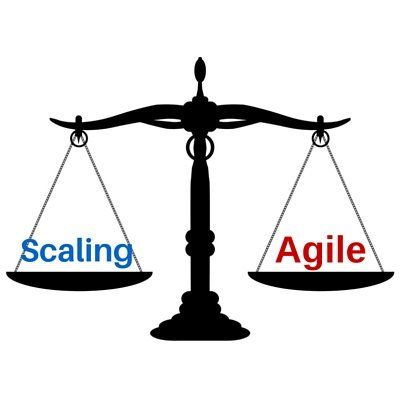
Scaling Agile is a hot topic. Adverts for courses on SAFe (Scaled Agile Framework) and LeSS (Large Scale Scrum) seem to be everywhere. Then there is DAD (Disciplined Agile Development – from IBM) and Enterprise Scrum and a few more approaches just emerging. The first advanced certifications announced by ScrumAlliance are concerned with scaling Scrum.
On first thought there is a kind of inevitability about this. Agile has been steadily advancing into mainstream software development since about 2008, and the slower moving large organizations such as global banks, international manufacturers and service providers, and even Government organizations, having had a taste are now preparing to eat their Agile lunch. The knee-jerk reaction is: let’s scale our Agile operations, especially for those big projects we always have. But, even though I am a SAFe Program Consultant (SPC) myself, I have a sneaking suspicion that many scaling efforts are misguided, and generate more waste than business value.
A Restaurant Analogy
Let me begin by introducing a restaurant analogy. Recently for the birthday celebration of an extended family member, my wife and I, together with a mob of relatives and friends, ate at a chain eatery in Coventry, England near where we live. It is one of those places where you pay a single price and then eat as much as you like from an enormous buffet. Indian, Chinese and Italian specialties are included. There are also a grill, a roast meats station, and a dessert counter. Each station has its own specialist crew of kitchen staff. They make sure that there is a constant supply of food items to keep the counters fully stocked.
One of the attractions of this restaurant is that it is cheap, so I’m guessing there is a major pressure on keeping costs low. Why then, do they employ so many in the kitchen? The answer is because all of the different food items are needed both all at once and continuously. Now compare this to a much more up-market Indian restaurant that, as a couple, we more regularly favour with our custom. It has a small kitchen and a correspondingly small kitchen staff. True, its throughput of customers is not the same as the Coventry one, but it is usually packed, and it has many more menu items than the big eatery. In either place we might eat a starter, a main and a dessert, but in our Indian restaurant the chef is cooking to-order and can start on the mains even while we are eating our starter. The other place has to have all the potential elements of the meal on offer at the same time.
Read more at http://blog.learningtree.com/uk/just-time-scaling_agile/